
Recognizing that excellence in safety is crucial…
Sustainability
CONNECTING TODAY TO A BETTER TOMORROW
From our CEO, Junai Maharaj
Our vision is to create a more sustainable future for all and our goal is to connect everything we do today to create a better tomorrow for our associates, communities, customers, suppliers, and shareholders.
Click here to read our full 2024 Sustainability Report.
 As part of our commitment to society, our people and the environment, Buckman completes a thorough assessment of its business sustainability practices every year through EcoVadis, a global leader in business sustainability assessments. The EcoVadis assessment includes 21 sustainability criteria across four core themes: Environment, Labor & Human Rights, Ethics and Sustainable Procurement.
In our latest rating, which was completed October 2025, we earned a Platinum Medal which places Buckman in the top 1% globally.
Click here to view Buckman’s EcoVadis Platinum highlights and here to visit our recognition page.
Our Sustainability Strategy
Every business practice at Buckman will sustain the health and well-being of people, the financial prosperity of our company and the wholesomeness of the environment on which we all depend. We make this commitment to ensure that future generations can achieve a quality of life that is the same or better than our own. Buckman’s commitment to sustainability is manifested in four areas: the quality of our work, the safety of our people, the support of our communities and the protection of our environment.
Buckman is committed to transparency in our reporting and to continuously improving the processes for sustainability management and performance. We use a cross-functional Corporate Sustainability Project Team for accountability and oversight in the preparation of this report and a management software program to track and oversee our progress toward our stated goals. A Global Operations Sustainability team meets monthly to discuss and share information on projects to reduce energy and water consumption, effluent, and waste. Quantitative data is collected at each operating facility, which allows us to monitor, track, and identify opportunities at both the local and global levels. We use the Global Reporting Initiative (GRI) Standards for sustainability reporting to provide the best possible disclosures based on the nature of our global business and the related risks and opportunities.
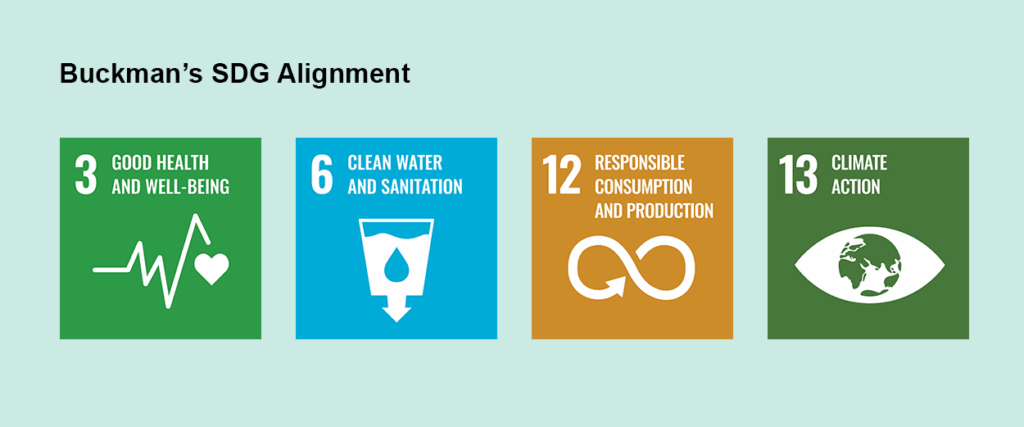
Our Focus Areas
Connected to Each Other
Connected to Society
Working hard to improve the quality of life of our associates, our local communities…
Connected to Our Future
Taking bold steps to ensure we remain a long-term, value-oriented, future-focused business.
Connected to Our Planet
Continuously improving our environmental management practices…
Buckman 2024 Sustainability Report
At Buckman, with 80 years behind us, sustainability is at the core of everything we do. We continuously evaluate and improve our environmental impact by reducing emissions, energy use, water consumption, and waste, to prioritize the safety and well-being of our employees, and empower our customers to enhance their own sustainability efforts through our solutions and services. Our journey is guided by clear metrics and data, ensuring transparency and accountability.
Read More